

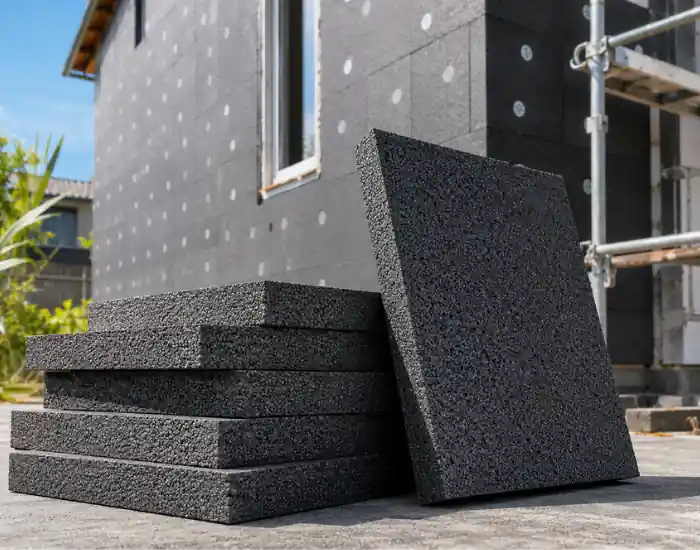
Have you ever wandered through an aisle of insulation materials at your local home DIY warehouse? Then you’ve likely seen boards of various colors such as pink, blue, pure white foam, and the now widely used gray insulation. One would think the color of a board is only branding. And yes, sometimes it is. There is, however, a specific characteristic of gray insulation that you should be aware of.
Both pink and blue boards are almost always made of extruded polystyrene, or XPS. They are dyed in order to make the product distinctive from others on the shelf. White foam is most likely expanded polystyrene, or EPS. It is made by expanding plastic beads using steam and molding them into large boards. While gray foam can be EPS, it features one unique attribute.
What Is It That Makes the Foam Gray?
The gray color comes from graphite – the same material that is used for pencils. Small particles of graphite are introduced into plastic beads during the manufacturing process. This results in the board being gray and the graphite inside changing the way it works as thermal insulation.
There are several ways heat passes through insulation: some of it transfers through the board, and some through the air trapped in it. Heat is transferred through the foam insulation material through the plastic structure, the gas in its cells, and through thermal radiation. The graphite granules play a role in reducing heat transfer through radiation, making this material better than white EPS. Graphite particles in EPS assist in absorbing and reflecting heat, thereby decreasing the heat transfer through the board.
Epsilyte is a company based in the United States that produces EPS and sells it to manufacturers making graphite EPS insulation. Because of its lower radiant heat transfer, the gray foam offers a higher R-value per inch than white EPS. Therefore, you can either achieve the same level of thermal protection with a thinner board or increase the insulating properties of the board with the same thickness.
Why Does It Matter?
White EPS has a thermal resistance value that ranges between R-3.6 and R-4.2 per inch, depending on the density of the board. The value of graphite EPS ranges from R-4.7 to R-5 per inch. Yes, the gap may seem small, but it matters, for example, when you need R-10 of continuous insulation according to the building codes.
This makes a difference not only because you need to install less material. On the exterior of the house, this results in a thinner foam layer, which requires shorter fasteners and smaller window trim. Inside the house, it means having some additional square footage in a finished basement. Less insulation material means also less weight to be transported and installed.
Other than this, gray EPS keeps all the advantages of EPS – its lightness, ease of installation, and good moisture resistance, allowing it to be used below the ground and under the concrete slabs. Its price may be slightly higher than white EPS, but most people find it worth the investment.
Is There Anything to Watch Out For?
Since the board is darker, it absorbs the heat from the sun. If left on a job site directly exposed to sunlight, it gets warm enough to cause warping. Therefore, most manufacturers recommend keeping gray boards under a light-colored tarp and protecting them from sun exposure after installation.
Conclusion
The gray coloration may be an indicator of the presence of graphite in the EPS to enhance insulation qualities. Yet color is not going to help you to choose the correct board for your house. The R-value and the material’s usage must be taken into account.

Comments are closed.